
By Selina Robertson and Helen de Witt
Introductions to the closing night of Goeth-Institut London’s season Elfi Mikesch: Constellations of Desire, May–June 2026.

Selina Robertson on The Blue Distance
Thank you Maren for inviting CDF to collaborate on this Elfi Mikesch season, it’s been a real treat and joy to see her films back in the cinema, some, possibly for the first time in London. Thank you Elisabeth and the ICA for hosting us this evening. Thank you everyone for coming this evening. I was in Hamburg this week and I met Monika Treut and told her about our screening this evening which she was happy to hear, she told me that young audiences are re-discovering her films of the 1980s with great enthusiasm because of the recent restorations.
Why did we decide to collaborate on this small season of Elfi Mikesch films? As Maren has said, the idea was trigged by the recent Werner Schroeter ‘Anguish & Ecstasy’ season at the ICA and also the death, last December, of Rosa von Praunheim, two hugely significant German filmmakers, who became benchmarks for future queer filmmaking. Yet when both these filmmakers have been remembered and honoured with retrospectives, there is one person who is hardly mentioned, yet she was one of their key collaborators: the cinematographer and writer/director Elfi Mikesch. Why so? As a film programmer and feminist cultural film historian, Mikesch’s absence from the cannon, the archive, and film history, I would argue, is a conscious and unconscious strategy of patriarchy, but we also might turn to Mikesch’s long term collaborator and friend von Praunheim for clues …. ‘ Elfi’ he said, ‘is one of the loveliest people I have all over the world who I admire free from envy. She only has one fault she is too modest. Thus, it is difficult to make the grand career, which she might deserve’.
Originally trained as a photographer, Mikesch is widely regarded as one of Germany’s most distinguished cinematographers, her key collaborations include von Praunheim, Schroeter, Monika Treut and Cynthia Beatt. Yet, alongside these collaborations, Mikesch has a dazzling and distinctive filmography. A body of work offers a singular field of vision, because of a deep engagement with the image, with looking, and a unique avant-garde approach to cinema as an art form.
In her 60-year long career, Mikesch has directed, filmed and edited, created set and magazine designs, as well as costumes, lighting and make up. Working in stills photography, tape/slide, super 8, 16mm, 35mm and digital, across film and television, she is 85 and in February received the Lifetime Achievement Award from the German Film Critics Association at the Berlinale. It is about time to rediscover her films, especially for today’s young cinephiles hungry for the radical potential of other film histories.
Mikesch was born in Judenburg, Austria in 1940, two years after the country’s annexation by Nazi Germany. From a young age, she lived in the cinema as her father worked as a projectionist. After graduating as a photographer, she moved to Innsbruck at the end of the 50s and married the painter Fritz Mikesch in 1960. The couple moved to West Berlin, where she began work as a stills photographer/ then filmmaker under the name ‘Oh Muvie’.
After further shorts and tape/slides, her first foray into filmmaking came through German television ZDF’s Das Kleine Fernsehspiel (The Little Television Play), a workshop department charged with developing new forms of television, one that promoted aesthetic experimentation and personal expression. The department commissioned her debut feature – I Often Think Of Hawaii in 1978, as well as many of the key films from the West German feminist film movement, also known as Frauenfilm (women’s film).
Mikesch places women at the centre of her films. They dominate her stories; they trigger her processes and vision. She does not distinguish between dreams, flights of fancy, real and artificial spaces, she mines landscapes of people’s life histories, their desires, thoughts and feelings. ‘I try to be authentic with the aid of imagination’, she says. Often her films are about women being emancipated from the patriarchal construct, the desire to burst out of one’s skin, to shift, to change identity. She captures people and things as equal aesthetic objects; all filmed with the same intensity and emotionality. Tilted camera positions, the use of black and white and colour film, surrealist dream fantasy sequences (Maya Deren remains a touch point), the use of collage, switching from documentary to fiction are Mikesch’s unique stylistic devices.
As with so much women’s and queer historical cinema, as a young film programmer and cinephile in the 90s, I first had to read about Mikesch before I saw her films in the cinema. I first encountered her work in Raymond Murray’s 1994 book, ‘Images in the Dark: An Encyclopaedia of Gay and Lesbian Film and Video’. In her entry, Murray quotes Annette Forster, the curator of Frameline, the San Francisco International Gay & Lesbian Film Festival, who in 1991 honoured Mikesch with a retrospective and a Frameline Award for significant contribution lesbian and gay media arts. Forster’s text in the festival catalogue always stayed with me. ‘With her excessive imagery Mikesch cuts a path through the jungle of patriarchal ideas and established cinematic language to reach the images of the other (ie. Women). Elfi Mikesch inscribes women’s images with passion, which is no less than an act of lesbian love’.
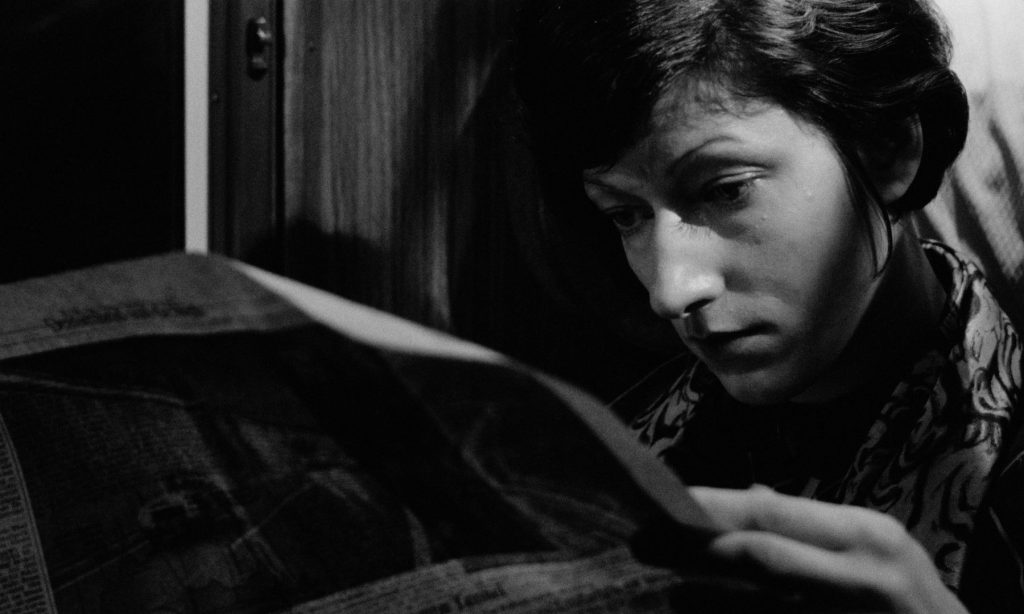
This ‘act of lesbian love’ is beautifully and mesmerizingly realised in The Blue Distance (1983). Drawing on the ‘imaginary letters’ of two lovers by German surrealist artist Unica Zurn, ‘the blue distance’, Mikesch evocatively writes, ‘is also the name given to the perspective of the Paris boulevards, which the gaze can perceive all the way to the indefinite horizon’.
The film is a technical tour de force, shot on 35mm, in a small train carriage, during a night’s journey between Berlin and Basel. Starring German actor and artist Silke Grossman as her double protagonist, it is a stunning reverie of light and shadow, a fabulously charged sensual mood piece circling two women’s desire for one another. Luggage, a shoe, leather gloves, a silk coat and coat hanger, the sounds of the train engine rush with a cinematic eroticism, fetishism and curiosity as a feminist counter-move, to conjure Laura Mulvey.
When I first saw The Blue Distance, I thought of experimental filmmaker Sandra Lahire, who made an equally erotic b/w 1 minute short Eerie (1991). about a dizzying lesbian kiss in a mountain cable car inspire by German expressionism. An interplay of glances and desires, had Lahire seen The Blue Distance I wondered? Perhaps at the London Filmmakers’ Coop. Lahire’s impassioned declaration about identity and oppression, ‘Whenever I am and come from, my tongue is Lesbian’ comes to mind whilst watching The Blue Distance. It is one of Mikesch’s few films that focuses on lesbianism as an explicit theme and a perfect filmic companion to Seduction: The Cruel Woman made two years later. The Blue Distance’s queerness carries multiple imaginations, textures, fictions and meanderings, engendered through Mikesch’s highly stylised experimentation and camp modernist sensibility, rooted in the socio-cultural politics of the 1980s West German cine-queer feminist movement.
Helen de Witt on Seduction: The Cruel Woman
Firstly, thanks so much to Maren Hobein and the Goethe Institute for their wonderful Elfi Mikesch season. So well deserved as her work is incredible in many ways and deserves to be better known. As Club Des Femmes, we feel privileged to have been involved and I’ve certainly leant a lot too. Thanks as well to the ICA for hosting this evening’s screening, which has helped make it accessible to a wider audience.
I first saw Seduction: The Cruel Woman at the infamous Scala cinema in the early 90s. It screened pretty regularly there and was a perfect film in away appealing to queer, experimental, art house and German film audiences as its still does, and wonderfully was made by two women, though I have to confess that I didn’t realise it was co-directed and I think it was credited solely to Monika Treut, thankfully this season has corrected that.
Selina has already spoken about Elfi, so I will concentrate on Monika. She was born in Monchengladbach in the mid-1950s and studied German literature and political science at the University of Marburg, So far, so conventional, but wait… her doctoral dissertation examined the representations of women in the writings of the Marquis de Sade and Leopold von Sacher-Masoch! I think we know where we are going now!
Clearly, her interest in sexuality, gender, desire, and sexually marginalised subjects, particularly women, were formulated at an early stage, and these are areas that she has explored throughout her oeuvre.
Even now her work seems daringly radical, but in the 1980s it was hugely controversial. Many feminists at that time took strong objection to it, as they viewed pornography, BDSM, and certain sexual practices primarily as forms of patriarchal oppression. Instead, Treut explored these subjects as sites of female agency, fantasy, and self-determination. This divide between what was sometimes known as the anti-pornography versus the pro-sex feminists ran deep throughout the 1980s.
Undeterred, Treut relentlessly pursued her interests in lesbian desire and identity, alternative sexual cultures and BDSM, gender fluidity and transgender experience, and queer communities. Working with Elfi Mikesh meant that together they developed a particular cinematic language that was adequate to make visible these identities and experiences and find means of expression for different forms of sexual politics.
For both of them, there were other the collaborators well, including Werner Schroeter who has just enjoyed a retrospective in this very cinema, and Rosa von Praunheim, one of Germany’s most radical and bold queer filmmakers, who sadly died last year.
Following from Monika’s early research into Sacher-Masoch and de Sade, Seduction: The Cruel Woman is a loose adaptation of Venus in Furs combined with elements from de Sade’s Justine. It is the film that established her internationally and remains one of the foundational works of lesbian and queer cinema and widely regarded as a groundbreaking queer film, made some years before the New Queer Cinema from the US in the early 1990s, trumpeted by the critic B. Ruby Rich.
The film merges performance art and erotic drama to explore power, desire, and gender through the lens of sadomasochism. It became a significant early example of feminist and queer cinema from Germany’s 1980s underground scene.
It established its controversial reputation at its 1985 Berlinale premiere. Contemporary accounts note that it provoked strong reactions because it openly depicted lesbian desire and sadomasochistic practices in a festival environment where such representations remained highly unusual. Ironic, then, that the films in this beautiful digital restoration was screened in Berlin this year to celebrate the 40th Anniversary of the Teddy Award for best queer film.
It was highly contentious for its depiction of BDSM and generated criticism not only from conservative institutions but also from some lesbian and feminist audiences. Others celebrated it as a radical challenge to conventional ideas about sexuality and power.
Following its debut, it played at queer festivals around the world including Frameline in San Francisco.
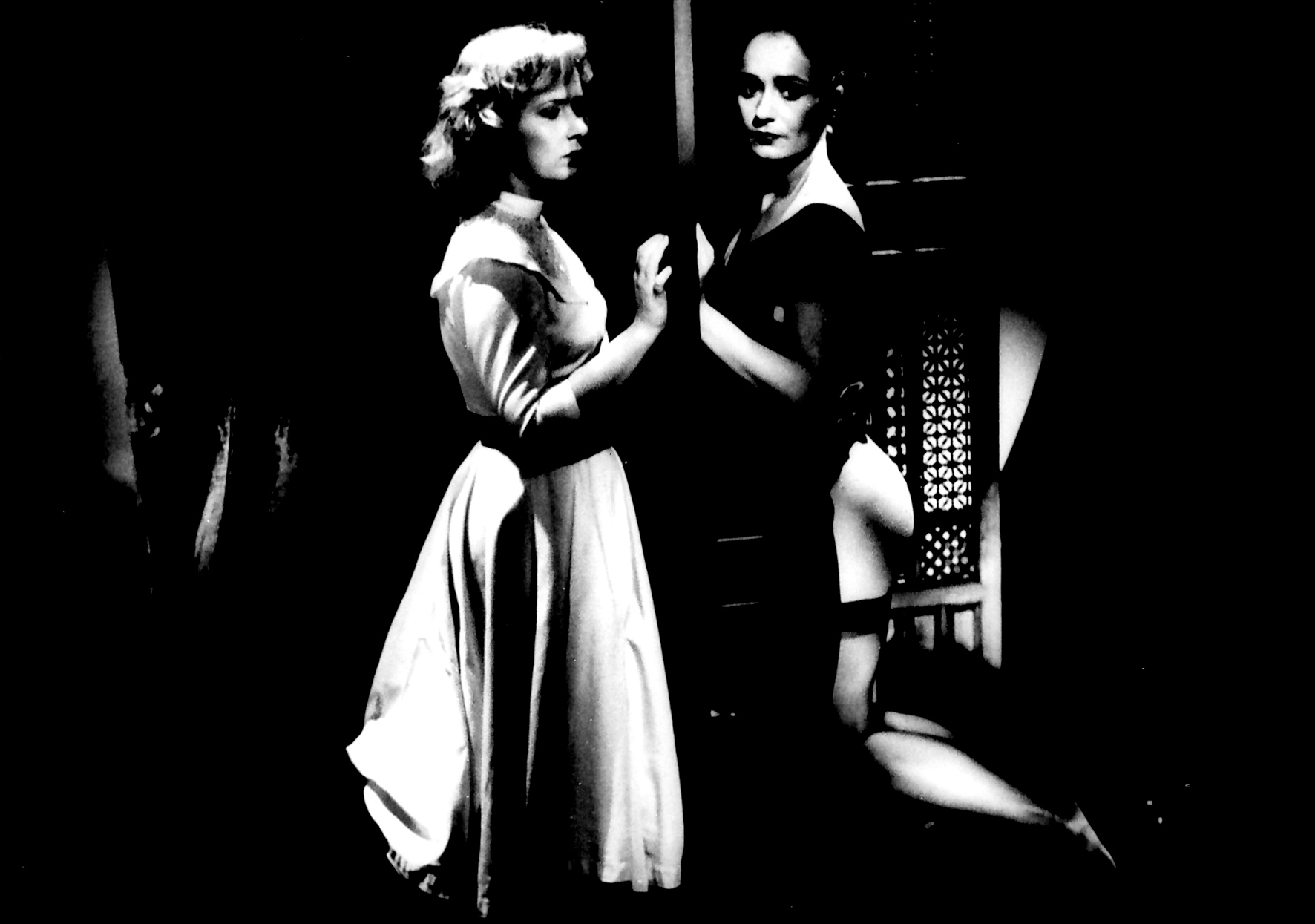
Rather than adapting Venus in Furs literally, Treut and Mikesch transplanted its themes into contemporary West Germany. It is set in Hamburg, and the story follows Wanda played magnificently by Mechthild Großmann, a dominatrix who operates a ‘gallery’ where sadomasochistic performances blur the boundaries between art and reality.
Her intricate emotional and sexual entanglements with lover Caren played by Carola Regnier; submissive Gregor (the wonderful Udo Kier); and naïve newcomer Justine, played by the radical American filmmaker Sheila McLaughlin, who directed another controversial lesbian film She Must be Seeing Things, made two years later. There is also a hilarious performance from the Austrian artist, curator and theorist Peter Weibel, as a journalist with quite specific needs. Through their respective roles, the film examines the dynamics of control, cruelty, and erotic imagination within this shifting network of lovers, disciples, voyeurs, and critics who become entangled in systems of desire and power.
Unlike many feminist films of the period that used realism or political didacticism to make their points, Seduction: The Cruel Woman is highly stylized and theatrical. Many feminist and queer viewers celebrated this approach because it placed female desire and lesbian sexuality at the centre of the narrative while portraying women as active agents rather than victims. The character Wanda controls both the narrative and the erotic economy of the film.
Mikesch’s poetic and visually experimental cinematography provides it with a constructed mise-en-scène that reflects its roots in both performance art and its source in literary sadomasochism. Its aesthetic detachment, combining a cool atmosphere with its transgressive sexual subject matter are explored through a series of tableaux rather than a conventional narrative structure.
Rich colour photography and slow, elegant camera movements capture artificial dreamlike interiors where we witness elaborate staged performances. It is easy to see the influence of cabaret with elements of surrealist camp. The gorgeous costumes are deliberately exaggerated and complete the fetish imagery.
Lots to enjoy, then, and I hope you do!