

By Selina Robertson
Thank you for coming this evening to the opening film in our season Constellations of Desire: The Films of Elfi Mikesch. When I was thinking about how to begin my introduction this evening, I thought about why now? why decide to present this season of Mikesch’s films to London audiences?

As Maren has said, the idea was trigged by the recent Werner Schroeter ‘Anguish & Ecstasy’ season at the ICA and also the death, last December, of Rosa von Praunheim, two hugely significant German filmmakers, who became benchmarks for future queer filmmaking. Yet when both these filmmakers have been remembered and honoured with retrospectives, there is one person who is hardly mentioned, yet she was one of their key collaborators: the cinematographer and writer/director Elfi Mikesch. Why so?
As a feminist film programmer and historian, Mikesch’s absence from the canon, the archive, hidden from history, I would argue, remains a strategy of patriarchy, but we also might turn to Mikesch’s long term collaborator and friend Rosa von Praunheim for clues: ‘ Elfi’ he said, ‘is one of the loveliest people I have all over the world who I admire free from envy. She only has one fault she is too modest. Thus, it is difficult to make the grand career, which she might deserve’.
Originally trained as a photographer, Mikesch is widely regarded as one of Germany’s most distinguished cinematographers, her key collaborations include von Praunheim, Schroeter, Monika Treut and Cynthia Beatt. Yet, alongside these collaborations, Mikesch has a dazzling and distinctive body of her own films. A body of work which, like her 70s cine-feminist contemporaries Agnes Varda and Babette Mangolte who also trained as photographers before moving into filmmaking – offers a unique field of vision, because of a deep engagement with the image, how to capture, create and construct the moving image.
‘I always wanted to make stories out of photographs’, Mikesch said early on in her career, ‘to create a dialogue between one picture and another. To me, two pictures represent a kind of film’. In her 60-year long career, Mikesch has directed, filmed and edited, created set and magazine designs, as well as costumes, lighting and make up. Working in stills photography, tape/slide, super 8, 16mm, 35mm and digital, across film and television, she is now 85 and has just received the Lifetime Achievement Award from the German Film Critics Association at the Berlinale. It is about time, especially for today’s young cinephiles hungry for the radical potential of other film histories, to discover her recently restored work.
Moreover, this season acts a feminist curatorial act of remembering, reclamation and restitution. For too long Mikesch has been missing from cinemas in the UK, in feminist and queer cultural and creative film memory. By bringing Mikesch’s films back into the cinema, audiences can appreciate not only the diversity 1970s and 1980s New German Cinema, but also as feminist film scholar Julia Knight writes, the ‘absent directors’ of that movement, namely the women, that includes Mikesch as well as Margarette von Trotta, Helma Sanders-Brahms, Ulrike Ottinger and Helke Sander among many others. Coming out and through West Germany’s women’s liberation movement, these women film directors of New German Cinema made a vital contribution to the development of a feminist and queer film culture in Germany, but also the UK, across Europe and the US. The impact of which is still felt today. We can see this legacy in Mascha Schilinski’s recent feminist film ‘The Sound of Falling’.
As with so much women’s and queer historical cinema, as a young cinephile, I first had to read about Mikesch before I saw her films in the cinema. In Mikesch’s case, it was Raymond Murray’s book, Images in the Dark: An Encyclopaedia of Gay and Lesbian Film and Video, from 1994, where Murray listed Mikesch as one of his favourite directors. At the end of the entry, Murray quotes Annette Forster, the curator of Frameline, the San Francisco International Gay & Lesbian Film Festival, who in 1991 honoured Mikesch with a retrospective and a Frameline Award for significant contribution lesbian and gay media arts. Forster’s text in the festival catalogue always stayed with me:
With her excessive imagery Mikesch cuts a path through the jungle of patriarchal ideas and established cinematic language to reach the images of the other (ie. Women). Elfi Mikesch inscribes women’s images with passion, which is no less than an act of lesbian love.
I also want to acknowledge Julia Knight’s 1992 book Women and the New German Cinema which was the first academic study (in English) of the women directors of New German Cinema.
In this season, audiences will have the opportunity to discover a constellation of Mikesch’s passionate cinema which (together with her contemporaries) laid the groundwork for a new feminist cinematic vocabulary. Unlike the distanced narration of modernist German cinema, the personal was political, these directors included the author (themselves) within the text.
When Maren asked Helen (my co-curator at CDF) and myself to choose which films of Mikesch we would like to introduce. We choose three of her, arguably most deliciously queer feminist films: I Often Think of Hawaii, Macumba (which Helen will be introducing on 18 May at the Goethe) and Seduction: The Cruel Woman (which we will both be introducing at the ICA on 7 June), in dialogue with three of her exquisite short films – The Breakfast of Hyenas, Execution – A Study of Mary and Blue Distance.
A quick biography. Mikesch was born in Judenburg, Austria in 1940, two years after the country’s annexation by Nazi Germany. From a young age, she lived in the cinema as her father worked as a projectionist. Feeling the constrictions of the countryside, after graduating as a photographer, she moved to Innsbruck at the end of the 50s and married the painter Fritz Mikesch in 1960. The couple moved to West Berlin, where she began work as a stills photographer under the name ‘Oh Muvie’. Oh Muvie, became the title of the first German photo novel developed with texts by von Praunheim, who went onto become her lifelong friend and collaborator.
In 1971, as a rite of passage for many ’68-ers of the era, she travelled across the world with von Praunheim and Fritz. After more shorts and tape/slides, her first foray into filmmaking came through an institutional initiative. Das Kleine Fernsehspiel (The Little Television Play) was charged with developing new forms of television, one that promoted aesthetic experimentation and person expression. This small workshop department at the German television channel ZDF played a particularly important role in enabling women filmmakers to develop their careers. The department commissioned I Often Think Of Hawaii as well as Sanders’ Redupers or The All-Round Reduced Personality (1977) among many of the key films from the West German feminist film movement. I Often Think of Hawaii was subsequently theatrically released through Filmwelt, a new left-wing distributor, who set out to change West Germany’s cinema landscape by distributing 16mm films to cine-clubs, non-commercial venues, to expand the range of films available. In particular documentary film, until then which had been ignored as a cinematic art-form.
As mentioned, as a cinematographer working across film and television, Mikesch’s key collaborations were with Schroeter (The Rose King), von Praunheim (throughout his career), Monika Treut with who she set up the production company Hyena Films in 1984, and Cynthia Beatt whose restored film The Party – Nature Morte (1991), starring Tilda Swinton, is being presented at Cinema Rediscovered in July. Since 1976 she has been making her own feature and documentary films and her most recent documentary Kreig oder Frieden (War or Peace) was completed in 2024.
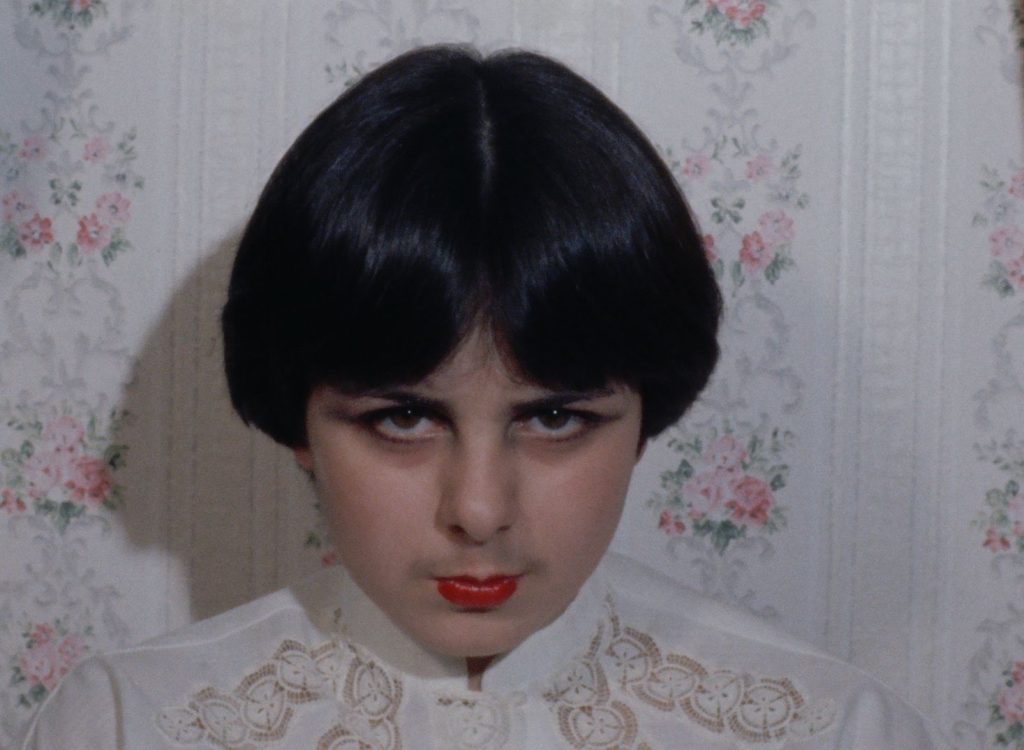
Mikesch places women at the centre of her films. They dominate her stories; they trigger her processes and vision. She does not distinguish between dreams, flights of fancy, real and artificial spaces, she mines landscapes of people’s life histories, their desires, thoughts and feelings. Mikesch has said, ‘I try to be authentic with the aid of imagination’. Often her films are about women being emancipated from the patriarchal construct, the desire to burst out of one’s skin, to change. She captures people and things as equal aesthetic objects; all filmed with the same intensity and emotionality. Tilted camera positions, the use of black and white and colour film, surrealist dream fantasy sequences (Maya Deren remains a touchpoint), the use of collage, switching from documentary to fiction are Mikesch’s unique stylistic devices. In the aftermath of WWII and the Nazi fascist era, West Germany of the 1970s had become Europe’s industrial engine through the Wirtschaftswunder (The Economic Miracle).
Yet artists, intellectuals, musicians, filmmakers and writers refracted and reflected a desire for a different world, something more other than a new Volkswagen or new fridge in their kitchens. In 1962 at the Oberhausen Short Film Festival, 26 filmmakers, writers and artists wrote the Oberhausen Manifesto, declaring ‘papa’s cinema is dead’. The arrival of the women’s movement in late 60s, early 70s had a profound effect on a variety of cultural practices, such as art, photography, drama, music and film, and by the mid 70s a women’s counter-culture began to emerge, which included political women’s cinema that came to be known as Frauenfilm (women’s film). Mikesch’s work during this period can be seen as part of this collision between the women’s movement and film. In fact, from 1978/80 Mikesch worked as the designer for the cover of the feminist film magazine Frauen und Film.
Mikesch’s vision arrived almost fully formed in her debut I Often Think of Hawaii, a beautiful heart-breaking film about 16-year-old Carmen Rossol and her family, her mother Ruth (a night cleaner), her brother Tito, and her Puerto Rican soldier father who exists as a projection in photographs, records of Hawaiian music and postcards, having abandoned the family, leaving only her mother’s memories of him: ‘he would have shown me the life’ she remembers in the film. The Rossols live in a newly built housing estate on the outskirts of West Berlin. Mikesch lived near the Rossols for twelve years, they were neighbours and saw each other from time to time.
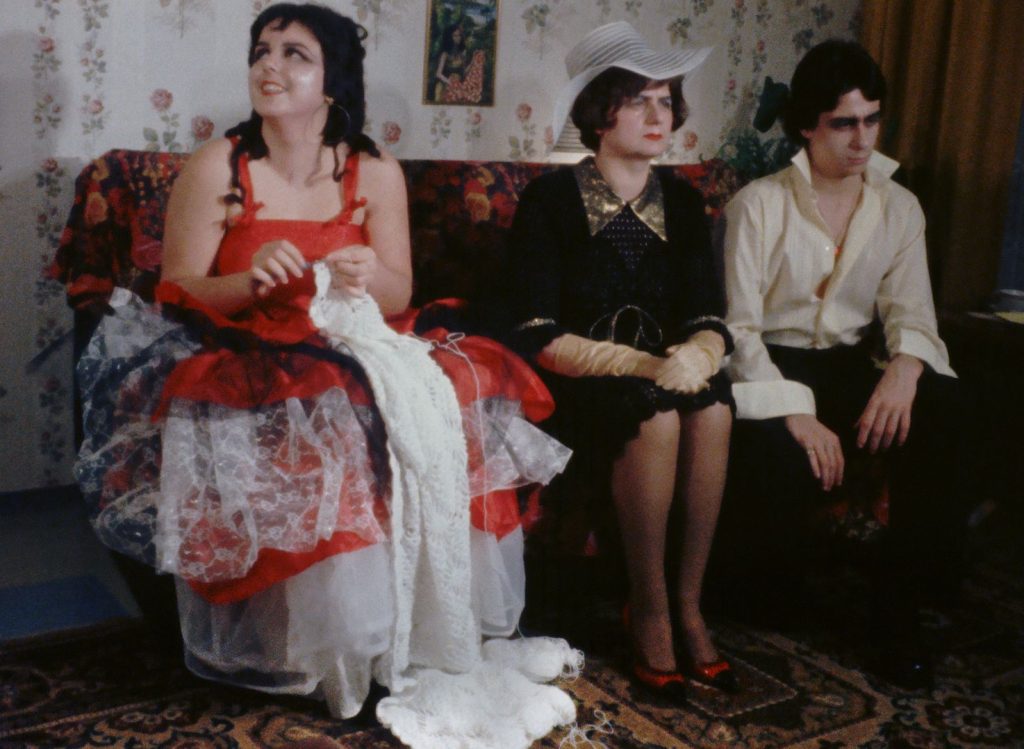
When Mikesch noticed a change in Carmen, she came upon the idea of making a film about her and her family. ‘About a year ago’ she said in an interview for Social Magazine in 1978, ’I noticed how much Carmen had changed over time. Her formerly delicate body had become huge, but her mouth had not grown with it. It looked tiny in her face with its large eyes, standing like a sign of Carmen’s reserve, of her speechlessness. I got the idea of making a film with Carmen, about her everyday life and her dreams. She was almost 16 then. I made the suggestion, and she agreed – there was even something like a small enthusiasm’.
Mikesch gives us a stunning fragmentary mood piece about that fleeting of moments between childhood and young girlhood. We discover Carmen’s dreams, longings, fantasies and romance, her hormonal unruliness, her truthfulness but also her intense boredom, stagnation, repetition and the drudgery of everyday life, and that particular loneliness that can be found in a city, in the monotony of high rise living. It is also an honest portrait of generational differences, the intimacy and impenetrability between a mother and daughter. ‘What did you do when you had a boyfriend’ … ‘What was it like when you were young?’ Carmen interrogates her mother, looking for truths where there are none.
Inspired by the camp aesthetics of American film underground (of Warhol, Anger and Smith) with its experimentation, aesthetic invention and modernist sensibility, yet rooted in the socio-cultural politics of the West German women’s movement, Mikesch meets her young protagonist on equal measure, offering her a means of escape and freedom and in turn, she asks the larger question about how do we live and connect, and what is means to be alive.

But before Hawaii, we are showing Mikesch’s 1983 short film The Hyena’s Breakfast, which marks another broad trend that emerged in women’s filmmaking during the eighties, namely the explicit exploration of women’s sexuality and lesbian sexuality. A number of women, including Mikesch, Monika Treut, Birgit Heim, Austrian artist VALIE EXPORT a decade earlier, had begun to explore the question of female identity and the liberating potential of sado-masochism. Treut and Mikesch viewed SM as more of an art form as personal expression. The Hyena’s Breakfast was one the first films to draw on SM and one that uses the practice as its liberating possibilities. It’s a beautiful black/white poetic film about desire starring Sheila McLaughlin (the director of lesbian feminist classic She Must Be Seeing Things from 1987).
Casting McLaughlin, who was part of the New York East Village radical theatre and lesbian scene that included the wow café’s Lois Weaver and Peggy Shaw, points to the transatlantic cross current feminist connections, new queer cinemas, influences and friendships between artists and filmmakers in America and West Germany at the time. The gorgeous catholic imagery and formal experimentation convey the ‘suffering’ of a woman who might be experiencing a symbolic coming out, as Mikesch seductively introduces SM into the woman’s sexual fantasies as means of realizing her own sexuality and control over her own body. The film can be seen as a cinema of ideas before Seduction: The Cruel Woman which we will be closing the season with on Sunday 7 June at the ICA. Hope to see you there!