
Sunday 7 June, 6.30pm
ICA, The Mall, London
Tickets £6, £3 Concessions and for Goethe-Institut language students & library members.
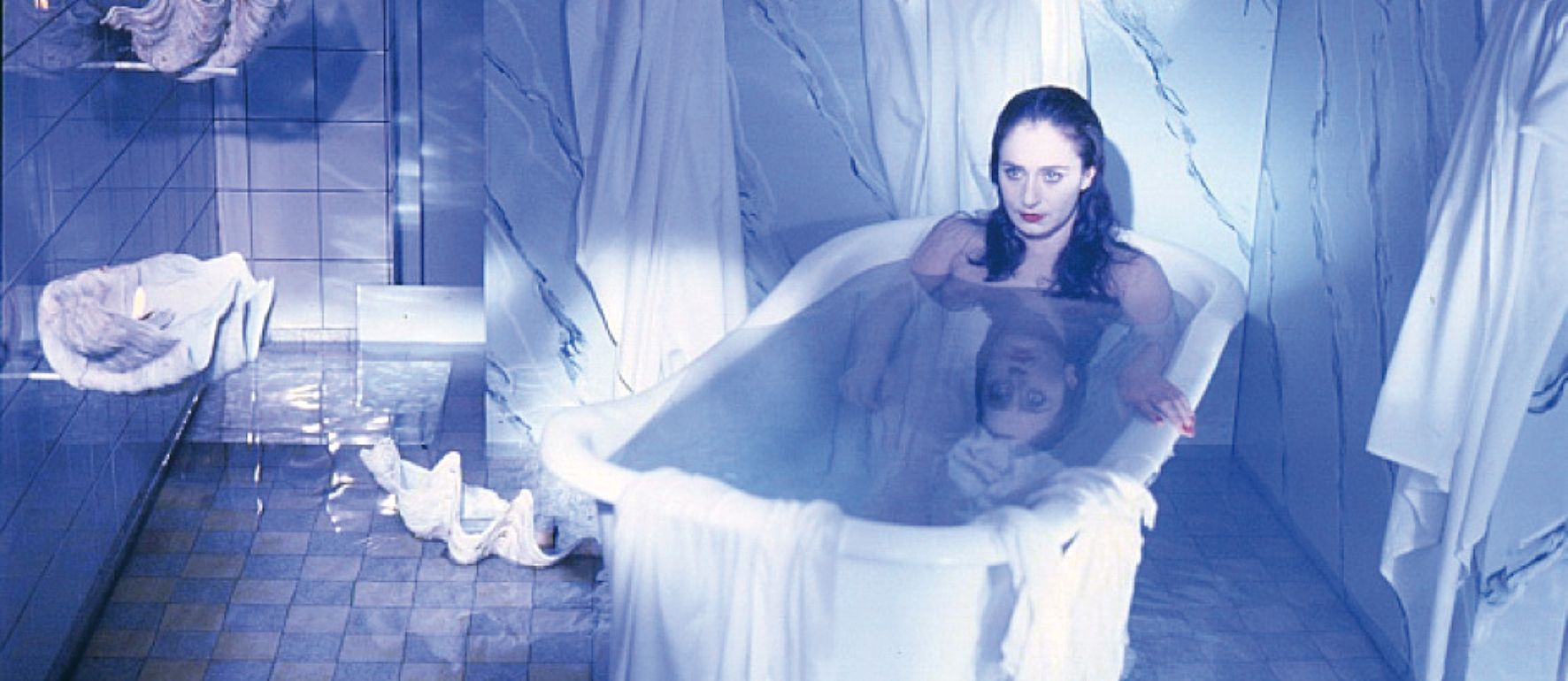
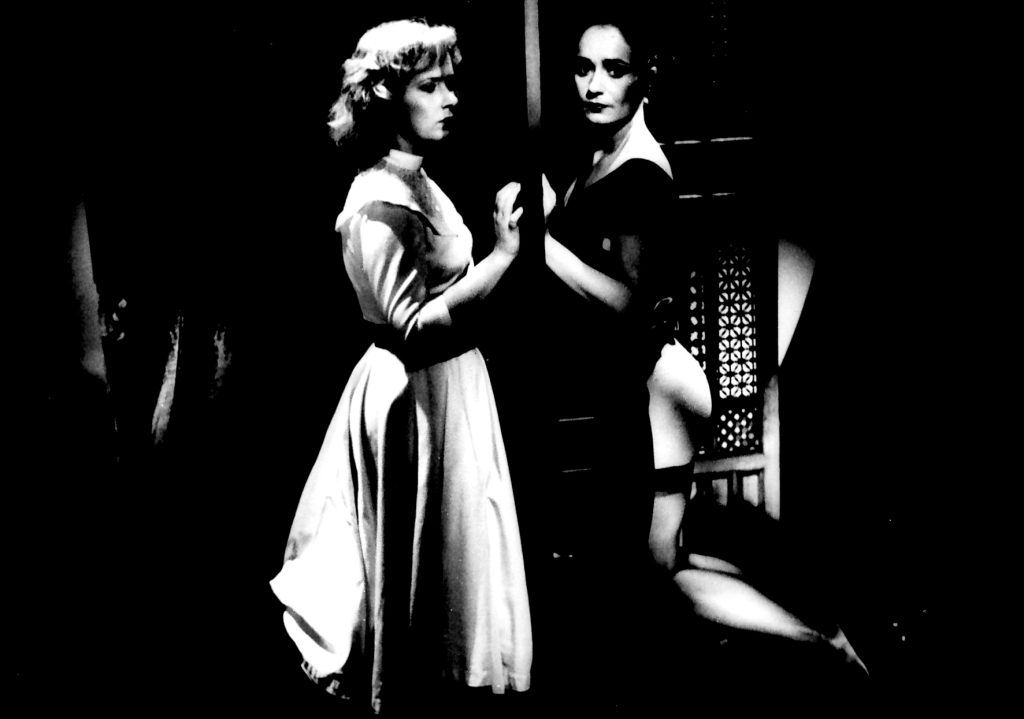
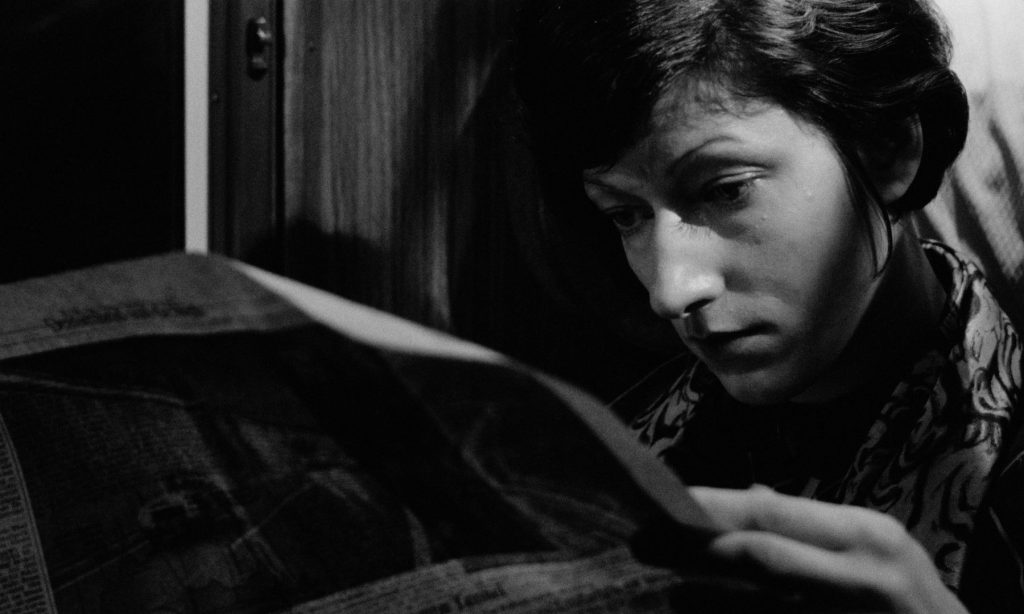
A provocative portrait of a ‘cruel’ dominatrix, co-written and directed by Elfi Mikesch and Monika Treut, Seduction: A Cruel Woman ignited controversy on its release for its bold subversion of power relations and unapologetic depiction of female lust. Once divisive, it is now considered as a landmark of queer cinema, celebrated for its exquisite mise-en-scène and Mikesch’s striking cinematography. It will be preceded by the short film The Blue Distance: on a night train, a woman meets a stranger – her double – perhaps a man, perhaps woman. A suitcase, its contents, a metronome, small metal objects, glances, shadow patterns. Elegant and enigmatic.
With an introduction by Selina Robertson and Helen de Witt.
The Blue Distance
West Germany 1983, 20 mins., digital (original format: 35mm), b/w, with English subtitles.
Written, directed, filmed, production, costume design and editing by Elfi Mikesch.
Seduction: The Cruel Woman
West Germany 1985, colour, digital (original format: 16mm – blown up to 35mm), 84 mins, with English subtitles.
Written and directed by Elfi Mikesch & Monika Treut, based on the novel “Venus in Furs” by Leopold Ritter von Sacher-Masoch.
More About the Films
The Blue Distance
“The blue distance” is the name given to the perspective of the boulevards of Paris, which the eye can perceive as far as the indefinite horizon. At the same time, it signifies the distance between two lovers in the letters of the artist Unica Zürn. In the film, a traveller encounters her own image, behind which her lover is concealed, sublimated by the lack of closeness. A phantasmagoria between dream and reality, during a night-time train journey between Berlin and Basel. “The image of those who set themselves in motion is threatening, whether in the motion of travelling or parting, of saying goodbye, only for those who have taken their place, where they are settled.” (source: Elfi Mikesch)
West Germany 1983, 20 mins., digital (original format: 35mm), b/w, with English subtitles.
Written, directed, and filmed by Elfi Mikesch, camera assistant: Wolfgang Pilgrim, production design, costumes: Elfi Mikesch, editing: Elfi Mikesch, production: OhMuvie-Film, premiere: February 1983, Berlin International Film Festival, International Forum of Young Cinema. With Silke Grossmann.
Seduction: The Cruel Woman
Wanda is a mysterious dominatrix and shrewd businesswoman. In her gallery in Hamburg’s harbour, she stages bizarre live shows for a paying audience: sadomasochistic rituals presented as an aesthetic form and a profitable business. In her private life, too, Wanda is an absolute ruler. She sets the rules of pleasure that her lovers must follow: A young and delicate Udo Kier plays her submissive, romantic stage partner, Gregor, who falls in love with her; Peter Weibel, the media and conceptual artist and later long-standing director of the ZKM | Center for Art and Media Karlsruhe, is a journalist who wants to interview Wanda and in the process discovers his masochistic streak. Wanda takes a particular interest in the young, innocent Justine, played by the American director Sheila McLaughlin (She Must Be Seeing Things, 1987). She is to be introduced to the business, much to the displeasure of Wanda’s older lover Caren, the owner of a shoe shop with a penchant for high-heeled shoes – played by the renowned stage and film actor Carola Regnier. Wanda – icily portrayed by Mechthild Großmann, a long-standing member of Pina Bausch’s Dance Theatre Wuppertal – holds them all under her spell.
“Thank you for this wonderful film,” Jean Baudrillard remarked after the press screening of Seduction: The Cruel Woman. But not everyone shared his appreciation. Based on motifs from Leopold Ritter von Sacher-Masoch’s novel Venus in Furs, the film, with its explicit BDSM scenes, drew criticism in 1985 not only from the then German Federal Minister of the Interior and the Catholic Film Service. The film was also the subject of heated debate in lesbian and feminist circles – some celebrated its subversive power, whilst others took issue with the radical display of sadomasochistic fantasies. Today, with its perfect aesthetics and dramatic intensity, the film is regarded as an avant-garde milestone that made Treut and Mikesch icons of queer indie cinema. (Source: Salzgeber, edited and expanded)
West Germany 1985, colour, digital (original format: 16mm – blown up to 35mm), 84 mins, with English subtitles.
Directed by Elfi Mikesch & Monika Treut, based on the novel ‘Venus’ in Furs by
Leopold Ritter von Sacher-Masoch, assistant director. Margit Czenki, Sandra Nettelbeck, cinematography: Elfi Mikesch, video: Monika Treut, camera assistants: Hanno Hart, Ulrike Zimmermann (video camera), lighting: Wolfgang Kluge, Peter Werner, set & stage technology: Reinhard Twardy, Dieter Wertz & Dietrich zur Nedden, sound: Cäsar Gremmler-Welgehausen, Frank Soletti, special effects: Reinhard Twardy, Set Design: Manfred Blösser, Props: Birgit Ruttkowski, Costumes: Anne Jud, Make-up: Rolf Baumann, Editing: Renate Merck, Music: Marran Gosov, Sound Mixing: Richard Borowski, Production Manager: Madeleine Backhaus, Line Producer: Hildegard Westbeld, Production Manager: Renèe Gundelach, Producers: Elfi Mikesch, Monika Treut, Production company: Hyena Films, DCP: Salzgeber.
Starring Mechthild Grossmann, Udo Kier, Sheila McLaughlin, Carola Regnier, Georgette Dee, Peter Weibel, Judith Flex, Barbara Ossenkopp, Daniela Ziegler, George Lanann, Jürg Schlachter.